Fictional Characters as Oshi: Japan’s IP Fandom Playbook


Fictional characters now sit at the heart of Japan’s ¥4.1 trillion oshikatsu economy. A 2026 ME-Q report counted 19.4 million active oshikatsu participants in Japan, and a growing share name an anime, game, or virtual idol as their primary oshi (ME-Q Oshi-Katsu Goods Guide, March 2026). Wikipedia’s oshikatsu entry recognizes fictional-character devotion as a formal sub-type alongside idols and athletes (Wikipedia). The shift matters for creators, because it reframes how studios design IP. Characters aren’t just protagonists anymore. They’re the product.
TL;DR
- Fictional-character oshi is one of three recognized oshikatsu sub-types, alongside real idols and athletes (Wikipedia).
- The otome game market hit $5.69 billion in 2025 and crosses $6.21 billion in 2026 (360iResearch, 2026).
- Genshin Impact passed $10 billion in lifetime player spending by end of 2025 (Business of Apps, 2026).
- The 2025 Sanrio Character Ranking pulled 63 million votes, up 111% year over year (Sanrio, 2025).
- Studios that design for fan devotion, not just plot, are winning the next decade of fandom spend.
What Counts as a Fictional Character Oshi in 2026?
A fictional character oshi is any non-real entity a fan actively supports through spending, attendance, or creative tribute. Wikipedia’s oshikatsu entry lists three recognized targets: idols, athletes, and fictional characters from anime, manga, games, or virtual platforms (Wikipedia). The category covers anime leads, otome game love interests, vocaloid voices, gacha-game banner units, and mascot IPs like Sanrio’s characters. It excludes named real performers, which fall under standard idol oshikatsu.
The framing matters because of how fans spend. Nomura Research Institute documented six oshikatsu spending lanes that map cleanly to fictional-character IP (Seoul Economic Daily, April 2026). They are merch, fan gifts, camera and filming gear, travel to events, support goods, and fan-funded billboards. A Sanrio Pompompurin fan and a real-idol fan share the same playbook.
The recognition is fresher than it sounds. As recently as the early 2020s, most academic and government coverage of oshikatsu treated character fandom as a separate “otaku” thread. The 2025 to 2026 Nomura, MIC, and MyNavi surveys folded it in. That change unlocks fictional-character oshi as a fundable category for retail, hospitality, and platform operators.
How Big Is the Fictional Character Oshi Economy?
The fictional-character slice of oshikatsu now anchors several multi-billion-dollar markets. The global otome game market hit $5.69 billion in 2025 and crosses $6.21 billion in 2026, with Japan holding 35% share (360iResearch, 2026). Genshin Impact, the highest-grossing character-driven mobile game ever, crossed $10 billion in lifetime player spending by the end of 2025 (Business of Apps, 2026). The virtual idol market sits at $2.01 billion in 2026 and is forecast to reach $22.62 billion by 2035 (Business Research Insights, 2026).
The category is broader than the franchise numbers suggest. Sanrio’s 2025 Character Ranking pulled 63,166,696 fan votes across 90 characters, a 111% jump from 2024 (Sanrio, 2025). Pompompurin won, with Cinnamoroll second and Pochacco third, the first dog-character podium sweep in the ranking’s 40-year history. Voter behavior in that ranking is pure oshikatsu signal. Fans don’t just like a character. They lobby for it.
What Design Choices Make Characters Feel Worth Supporting?
Studios that win fictional-character oshi share a tight design playbook. Genshin Impact’s revenue cycle illustrates the math. Monthly revenue swings hard with character banner quality, because spending collapses when no compelling units are live (Business of Apps, 2026). Japan posts the highest per-download revenue at $96.02, more than any other market. Fans pay for characters, not for the game.
The shared design pattern across winning IPs has four levers. First, a deep, multi-source backstory the fan can study (manga, side novels, drama CDs, voice clips). Second, a distinct voice and silhouette, often anchored by a named voice actor. Third, opt-in customization so the fan can imprint their own taste (alt costumes, voice lines, room decor). Fourth, accessibility across mobile, console, web, and merch, so the fan can engage in five-minute windows or three-hour ones.
Hatsune Miku is the cleanest example of all four. Her base voicebank ships as software, so any creator can produce her songs. The community has authored tens of thousands of tracks, and the official 2026 Miku Expo tour runs across Chicago, Los Angeles, Seattle, Vancouver, Dallas, Boston, and Mexico City between April 12 and May 19 (Dexerto, 2026). Hatsune Miku VOLTAGE Live at LaLa Arena Tokyo-Bay ran March 20 to 22 (Trend Hunter, 2026). She’s a fictional character with a real concert calendar.
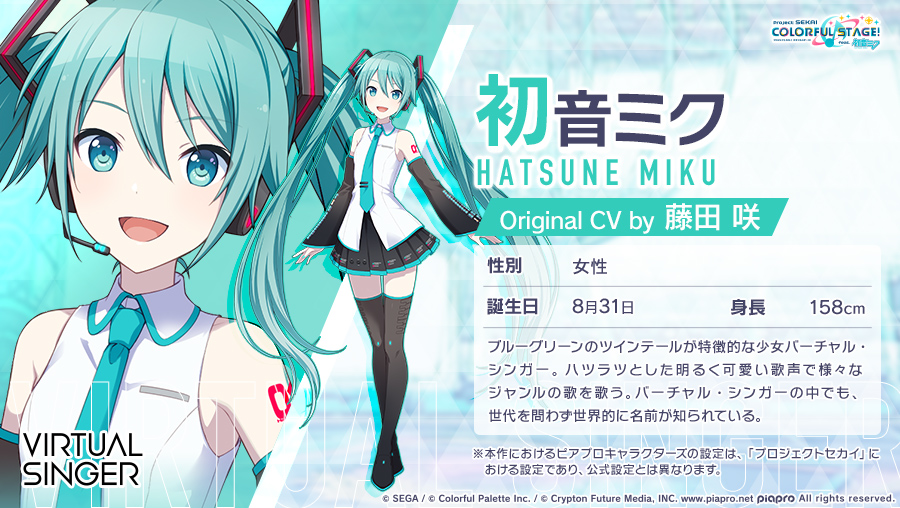
Image from Sekaipedia.org
Otome game studios run the same playbook in a different format. Voltage Inc., Idea Factory, Otomate, Tencent, NetEase, and NTT Solmare all release new character routes on a regular cadence (360iResearch, 2026). The character is the seasonal content. The plot wraps around them. For a deeper look at how virtual performance tech is shaping this space, see our history of virtual idols from Hatsune Miku to K-pop AI girl groups.
Why Are Fictional Characters Outperforming Real Idols in 2026?
Fictional characters keep gaining ground because they sidestep three friction points of real-idol fandom. They don’t graduate, retire, or have scandals. They scale to global audiences without travel logistics. And they invite participatory creation in a way human idols rarely can.
The growth math reflects that. The virtual idol market is projected to grow from $2.01 billion in 2026 to $22.62 billion by 2035, an 11x increase in nine years (Business Research Insights, 2026). Compare that against the broader oshikatsu market, which sits at ¥4.1 trillion (about $27 billion USD at ¥150 to the dollar) and is growing in single digits (ME-Q Oshi-Katsu Goods Guide, March 2026). The fictional slice is the fastest-growing sub-category.
Cross-IP collaboration accelerates the pull. Hatsune Miku alone has featured in more than 180 brand partnerships (Business Research Insights, 2026). Major virtual idols collectively reach over 80 million subscribers across social platforms. Anime-driven fandom drives parallel volume. Oshi no Ko, the manga that put oshikatsu into Western pop vocabulary, hit 25 million copies in circulation by December 2025 and aired its third season from January to March 2026 (Wikipedia, 2026). A fourth and final season has been announced.
What Does Browser-Based Fandom Add to Fictional Character Oshi?
Browser-based virtual worlds give fictional-character fans a low-friction venue to gather. Fans can host watch-along rooms for a new anime episode, build personal display rooms for a favorite character, and attend community concerts without a headset purchase or app install. The bar to entry sits at a URL.
The match is structural. Fictional-character oshi already lives online for most fans, through fan art platforms, fan fiction sites, and Discord servers. A browser-based 3D layer adds spatial presence on top of that. A fan can walk through a recreation of an anime cafe, watch the latest episode with strangers who pulled the same gacha banner, or step into a community-built shrine room for their oshi.
What Should Creators Take From Japan’s Playbook?
Western studios designing characters for 2026 fandom should treat the character as the product, not the plot. The five-point checklist below maps the Japanese playbook to practical decisions Western devs can apply this quarter.
- Design for the side novel before the main game. Fans want depth that survives the credits roll. Voice lines, room descriptions, voice actor interviews, all of it compounds.
- Ship the character across formats early. Mobile, web, console, plush, acrylic stand, soundtrack. Hatsune Miku’s voicebank-as-software model is the extreme version.
- Open a participatory layer. Free assets for fan creators, named modding-friendly file formats, and clear IP usage guidelines unlock community output.
- Run a recurring fan-vote moment. Sanrio’s annual ranking pulls 63 million votes (Sanrio, 2025). That’s a yearly free spike of engagement and PR.
- Be platform-neutral on delivery. Browser-first delivery removes the install friction that kills casual oshi recruitment.
The last point is where browser-based platforms earn a seat at the table. A fan who tries an oshi-tied 3D world from a tweet link, and stays for a 20-minute watch-along, has crossed a meaningful engagement threshold. No app store gate. No hardware ask.
For creators building inside this space, the VIVERSE Partner Program supports studios shipping browser-based fan worlds and character experiences. The Creator Grants program helps fund early projects from indie devs and small teams.
Frequently Asked Questions
What is the difference between a fictional character oshi and a real idol oshi?
A fictional character oshi is a non-real entity such as an anime lead, game character, or virtual idol that a fan supports through spending and creative tribute (Wikipedia). A real idol oshi is a named human performer. Both follow the same six oshikatsu spending lanes documented by Nomura Research Institute (Seoul Economic Daily, 2026).
How much do fans spend on fictional character oshi?
Spending varies by franchise. Japan posts the highest per-download revenue on Genshin Impact at $96.02 (Business of Apps, 2026). Cross-franchise oshikatsu spend averages about ¥250,000 per active fan per year (Tokyo Weekender, 2026). Fans in their 50s spend the most, averaging ¥99,000 per year.
Why is the virtual idol market growing so fast?
The global virtual idol market sits at $2.01 billion in 2026 and is forecast to hit $22.62 billion by 2035, an 11x climb (Business Research Insights, 2026). Growth drivers include cross-platform delivery, cheap merchandise scaling, no human-talent retirement risk, and easier global touring through holographic and browser-based performance tech.
Can Western studios design fictional characters that drive oshikatsu spending?
Yes, and several already do. Genshin Impact, originally a Chinese title from miHoYo, generates the majority of its mobile revenue from Japan and North America (Business of Apps, 2026). The design pattern travels. Depth of backstory, distinct voice, customization, and cross-format delivery matter more than geographic origin.
The Bottom Line for Creators in 2026
Fictional characters are no longer a sideshow in Japan’s fan economy. They anchor an otome market on track for $6.21 billion in 2026, a virtual idol market sprinting toward $22.62 billion by 2035, and a Genshin Impact run past $10 billion in lifetime spend. The IP-design lessons are clear. Treat the character as the product, ship across formats, open a fan-creation layer, and meet the audience on the lowest-friction channel available.
Browser-based platforms are that channel for a growing share of fandom activity. If you’re designing or porting a character-driven experience, start with a web build. For practical guidance, read our WebXR delivery guide or explore VIVERSE Create to publish a browser-first fan world this quarter.