Next-Gen Gaming in 2026: What Comes After PS5 and Xbox Series X?

Next-Gen Gaming in 2026: What Comes After PS5 and Xbox Series X?
The next “next-gen” isn’t going to look like the last one. PS5 lifetime sales hit 92.2 million units by the end of 2025. That sounds impressive until you compare it to PS4. PS4 had reached 117.2 million at the same point in its lifecycle. Sony’s own Q3 FY25 numbers came in down 1.5 million units year-over-year. Meanwhile, Sony just raised the price of a five-year-old PS5 to $649.99 in the US. PS6 is rumored for 2028 or 2029. Xbox isn’t even committing to another big-box console. So what actually comes after PS5 and Xbox Series X? The honest answer is: a lot of things, all at once. Here’s what next-gen gaming actually looks like in 2026.
Are PS5 and Xbox Series X Already at the End of Their Run?
PS5 became Sony’s second-best-selling console at 92.2 million units, but the curve is flattening fast. Sony shipped 8.0 million PS5 units in Q3 FY25. That’s down 1.5 million from the same quarter the year before (Push Square, 2026). At the equivalent point in its cycle, PS4 was 25 million units ahead. PS5 is going to land well short of PS4’s eventual 117.2 million total.
The Xbox side is harder to read because Microsoft does not disclose Series X|S unit sales. What they do disclose is direction. Xbox president Sarah Bond has framed the next Xbox as “a very premium, very high-end curated experience” (Variety, 2025). The new ROG Xbox Ally handheld, built in partnership with AMD and ASUS, signals Microsoft’s actual focus.
Then there’s Nintendo Switch 2. It hit 10.36 million units after launch, the biggest console launch in industry history (HardForum citing Nintendo earnings, 2025). Sony, meanwhile, forecasts Game & Network Services sales down 6% in FY26.
Our take: What this all adds up to is unusual. PS5 is the second-best PlayStation ever but trailing the trend line. Xbox is openly de-emphasizing big-box hardware. The console doing the biggest numbers is the hybrid handheld. That’s not a typical end-of-cycle pattern. That’s a market quietly redefining what “next-gen gaming” even means.
Why Are Console Prices Climbing Instead of Falling?
Consoles used to get cheaper over their lifecycles. Not this generation. The PS5 Disc rose to $649.99 in the US on April 2, 2026. That’s up $150 from its $499 launch price in November 2020 (PlayStation Blog, 2026). PS5 Pro climbed to $899.99. The UK PS5 Disc hit £569.99. Japan went to ¥97,980. These aren’t launch prices on new hardware. These are mid-cycle price hikes on the same machine Sony shipped six years ago.
What’s driving it? Supply-chain cost pressure from AI-related DRAM and HBM demand, weaker yen, and tariffs in some regions. The chips Sony needs for PS5 and PS6 share wafer capacity with AI accelerators. When that capacity gets scarce, console economics tip the wrong way.
For context, the original PS3 launched at $499 (20GB) and $599 (60GB) back in 2006. That was widely panned at the time as too expensive. Sony just blew past that in 2026, on hardware that’s already six years old.
What Do We Actually Know About PS6 and Xbox’s Next Console?
The PS6 timeline keeps slipping. Bloomberg reported in February 2026 that Sony is evaluating a shift from late-2027 to 2028 or 2029 (TechPowerUp summary, 2026). The delay is driven by RAM and HBM shortages tied to AI demand. If 2029 happens, that’s a 9-year gap between PS5 and PS6. That would be the longest generational stretch in PlayStation history.

On specs, the leak consensus points to a custom AMD APU. It pairs Zen 6 CPU cores with an RDNA 5 GPU (GamesRadar, 2026). A handheld companion device codenamed “Canis” is also rumored. These details come from supply-chain leakers and AMD insiders, not Sony confirmations. Treat them as directional, not final.
Xbox is harder to predict because Microsoft’s strategy doesn’t fit the old “ship a successor box” playbook. Sarah Bond said in late 2025 that hardware remains “absolutely core to Xbox” (Pure Xbox, 2025). At the same time, Microsoft is shipping its first-party games on PS5. Indiana Jones and Sea of Thieves both went multi-platform. Microsoft is also launching a handheld PC (ROG Xbox Ally) and routing players through Game Pass on any device.
The honest read is that “next Xbox” probably means a family of devices, not one. A high-end living-room machine, a handheld, and a cloud-streaming tier likely sit alongside Windows PC. PlayStation itself may even act as an endpoint for the same library.
Where Is “Next-Gen” Actually Headed in 2026?
The next “next-gen” is already happening, just not where most people are looking. Cloud gaming is projected to grow from $15.74B in 2025 to $121.77B by 2032. That’s a 33.9% compound annual rate (Electro IQ, 2025). GeForce NOW already has over 30 million registered users across 100+ countries. Xbox Cloud Gaming had 20M+ users as of its last public disclosure in 2023.
Sony’s own first-party PC strategy tells the same story. Steam sales of Sony titles brought in around $1.5B in 2025. PC now accounts for roughly 30% of Sony’s first-party revenue. That’s up from under 20% in 2022 (Push Square / Alinea Analytics, 2025). Helldivers 2 grossed about $400M and outsold its PS5 version more than 2-to-1 on PC.
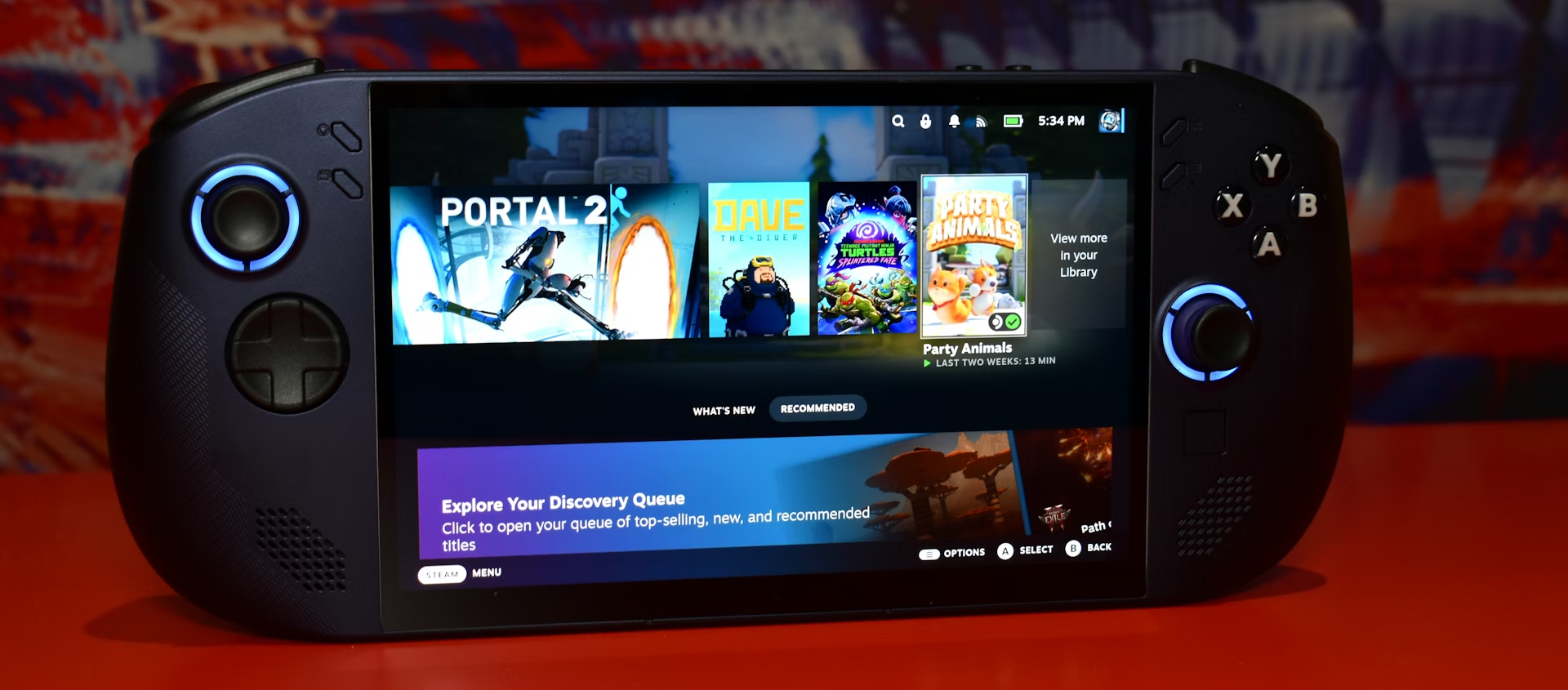
Handhelds are the other big shift. Steam Deck reached about 4 million lifetime units by end of 2024 (Nintendo Life, 2025). Total PC handhelds (ROG Ally, Lenovo Legion Go, MSI Claw) sat near 8 million cumulative. None of these are “consoles” in the old sense. All of them play AAA games. Most of them run Windows, Linux, or a custom Linux fork.
How Does Browser-Native Gaming Fit Into the Next-Gen Picture?
Browser gaming is the lane most “what comes next” articles miss. Roughly 15,000 new browser games shipped in the first half of 2025. That’s about 2.7 times the H1 2024 count (Playgama, 2025). About 16% of game developers report working on browser releases, up from 10% in 2024. Unity now powers around 55% of new web games. The browser-game market reached $18.5B in 2023 and tracks to roughly $45B by 2033.
Why does that matter for next-gen gaming? Because the browser is a platform that runs on every “next-gen” endpoint you can name. PS5 has a built-in browser. Xbox does too. Steam Deck does. Every PC, phone, tablet, Quest headset, and AVP runs a browser. A WebXR game ships once and reaches all of them. No install, no platform certification, no 30% storefront cut. That’s a structurally different value proposition than what console makers offer.
When we work with creators who started on Steam or mobile and ported to VIVERSE, the pattern is consistent. Players who jump in through a browser link convert at far higher session-1 rates. Those who wait through any install step bounce far more often. That’s not a console-vs-PC fight. It’s a different distribution model the console wars haven’t priced in yet.
> Citation Capsule: New browser game releases on tracked platforms reached 15,000+ in H1 2025, a 2.7x jump over H1 2024. Developer participation in browser games rose from 10% in 2024 to 16% in 2025 (Playgama, 2025). The browser-game market is projected to grow from $18.5B in 2023 to $45.2B by 2033, per Data Horizzon Research.
Frequently Asked Questions
When will PS6 release?
PS6 is currently rumored for a 2028 or 2029 launch window. Bloomberg reported in February 2026 that Sony is evaluating a delay from the original late-2027 target. The delay is driven by RAM and HBM memory shortages tied to AI demand (TechPowerUp, 2026). A 2029 launch would create the longest gap between PlayStation generations in history.
Will Xbox release another console after Series X?
Microsoft confirms that hardware remains “absolutely core” to Xbox (Pure Xbox, 2025). Sarah Bond described the next Xbox as a “very premium, very high-end curated experience.” The ROG Xbox Ally handheld signals that next-gen Xbox means a family of devices, not one box. Cloud and PC will likely play larger roles than ever.
Is cloud gaming replacing consoles?
Cloud gaming is growing fast but not replacing consoles outright. GeForce NOW has 30M+ users globally, and Xbox Cloud Gaming had 20M+ as of 2023. The market projects to grow from $15.74B in 2025 to $121.77B by 2032 (Electro IQ, 2025). For now it expands access rather than replaces dedicated hardware.
What is the next big platform after PS5 and Xbox Series X?
There isn’t one single answer. PS6 will arrive eventually, likely in 2028-2029. But the bigger shift is platform fragmentation. PC, cloud streaming, Steam Deck and other handhelds, Switch 2, and browser games are all growing at the same time. Next-gen gaming in 2026 means many endpoints, not one winner.
Is PC gaming better than console in 2026?
It depends on what you value. PC offers higher peak performance, mods, and library access including most former console exclusives. Sony’s first-party PC revenue hit $1.5B in 2025, about 30% of total first-party income (Push Square, 2025). Console still wins on price, plug-and-play simplicity, and platform-exclusive social features.
What Comes Next: A Quick Recap
The “next-gen” question used to have a clean answer. You pick a side, buy the box, and play the exclusives. That model is fracturing in 2026. PS5 is slowing while prices climb. PS6 keeps slipping. Xbox is moving toward a multi-device strategy instead of a single successor box. Switch 2, Steam Deck, ROG Ally, and other handhelds are pulling players in different directions at once. Cloud gaming is heading toward a $120B market by 2032. Browser-native games shipped 15,000 new titles in just six months. The next “next-gen” isn’t a console launch event. It’s a market where every screen becomes a gaming endpoint. The developers who win are the ones who ship everywhere.