Metaverse Meaning in 2026: What It Is and Why It’s Not Dead



If you searched for the metaverse meaning lately, you probably got a decade of conflicting answers. Some say it’s the future of the internet. Others say it died with the 2021 hype. Both are wrong. The metaverse is simpler than the marketing made it sound, and it’s very much alive.
Here’s the honest version. More than 600 million people use metaverse platforms every month right now (DemandSage, 2026). They just don’t strap on a headset to do it. This guide explains what the word actually means, who uses it, and where it lives in 2026.
TL;DR
- The metaverse is a network of shared 3D spaces you enter as an avatar, alone or with others
- Over 600 million people use metaverse platforms monthly (DemandSage, 2026)
- The market reached $150.1B in 2026, forecast to hit $507.8B by 2030 at a 35.63% CAGR (Statista, 2026)
- Roblox, Fortnite, and Minecraft each pull well over 150 million monthly users
Metaverse Meaning: The Plain-English Definition
The metaverse meaning is straightforward. It’s a network of connected 3D spaces you enter as an avatar. You can build, play, shop, or just hang out. Think of it as the 3D layer of the internet, not a single product you buy.
The word itself is old. Author Neal Stephenson coined “metaverse” in his 1992 novel Snow Crash. He described a virtual city people visited through goggles. The idea sat in science fiction for thirty years. Then the technology finally caught up.
Three traits separate a real metaverse space from a normal game. It’s persistent, so the world keeps running after you leave. It’s social, so other people share the space with you. And it’s embodied, meaning you show up as an avatar with a sense of presence.
You don’t need a headset that can run from several hundred to a couple thousand dollars for any of that. A phone or a laptop browser works fine. That gap between the hype and the reality is why the definition got so muddy. For the deeper culture side, see our look at how digital platforms unite people across the globe.
Is the Metaverse Dead in 2026?
No, the metaverse is not dead. The headlines saying otherwise are tracking one company’s retreat, not the whole category. In early 2026, a high-profile VR platform cut staff and shifted its focus to mobile and AI. That story got framed as the death of the metaverse.
The numbers tell a different story. More than 600 million people use metaverse platforms every month (DemandSage, 2026). Roughly 25% of people are expected to spend at least one hour a day in these spaces by 2026. User penetration sits near 21.2% this year (Statista, 2026).
What actually died was one narrow vision. The “buy an expensive headset and live in VR” pitch never found a mass audience. Meanwhile, the browser-and-phone version quietly grew into the hundreds of millions. Same idea, different doorway.
Who Actually Uses the Metaverse Right Now?
Hundreds of millions of people do, and most of them are young. Roblox reports 214 million monthly active users in 2026 (DemandSage, 2026). Fortnite pulls 236 million, and Minecraft adds another 166 million. None of those require a VR headset.
The audience skews young by a wide margin. About 83.5% of metaverse users are under 18, and 51% are 13 or younger (DemandSage, 2026). For a generation raised on Roblox, a 3D social space isn’t futuristic. It’s just where friends already hang out.
Headset-native communities are smaller but loyal. VRChat hit a record 148,886 concurrent users on New Year’s Day 2026 (ActivePlayer.io, 2026). That’s a fraction of Roblox, yet it shows real demand for deeper immersion. Both audiences count as the metaverse.
What Are the Main Metaverse Platforms in 2026?
The biggest metaverse platforms aren’t the ones from the 2021 headlines. They’re the games and social worlds people already open every day. Roblox and Fortnite lead on raw scale. VRChat leads on immersion. Web-first platforms like VIVERSE lead on access.
Each platform fits a different need. Some are creative sandboxes. Some are concert and event venues. Some are social hangouts you reach from a browser tab. The table below sorts the main 2026 options by how you actually use them.
| Platform | Best for | Headset needed? | How you join |
|---|---|---|---|
| Roblox | User-made games, young creators | No | App or browser |
| Fortnite | Events, concerts, battle royale | No | App download |
| Minecraft | Building, sandbox creativity | No | App download |
| VRChat | Deep social VR, avatars | Optional | App, best in VR |
| VIVERSE | Web-first games, apps, and more, no install | No | Any browser |
Sources: DemandSage and ActivePlayer.io, 2026.
The common thread is choice. You can enter as a casual player on a phone. You can go deep with a headset and full motion. The metaverse meaning stretches across all of it. For a hands-on start, here’s where to learn more on creating and publishing your content on VIVERSE.
Why the Browser Is the Metaverse’s Real Home
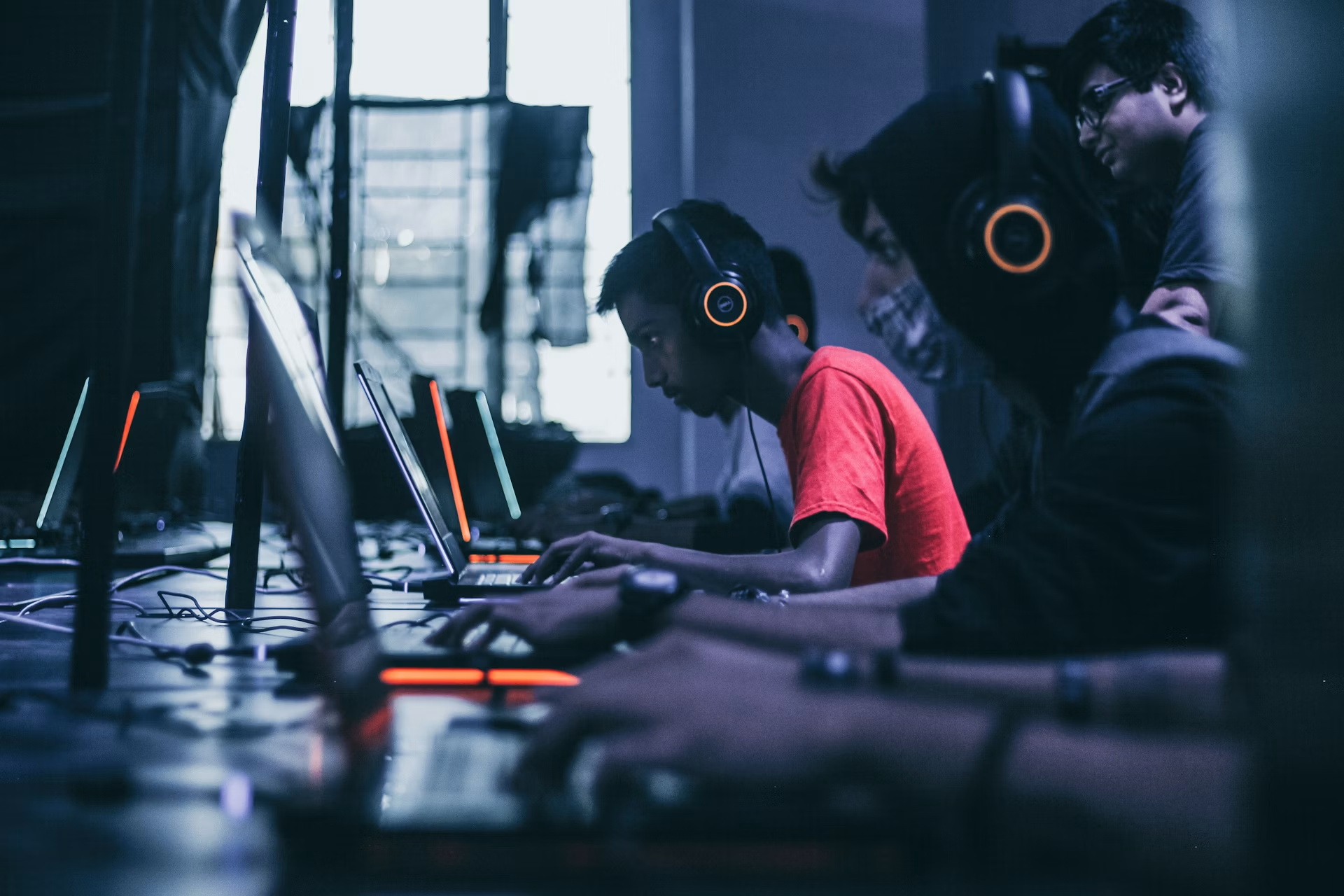
The browser is where the metaverse actually scales. Roughly 5 billion people own a device with a modern browser. That dwarfs the install base of every VR headset combined. No download, no store approval, no large purchase stands in the way.
Access drives the gap. A headset world asks for a big commitment before the first session. A browser world opens from a link in seconds. That difference is why the web-first platforms kept growing while the headset-only pitch stalled out.
WebXR makes the bridge work both ways. The same browser world can render flat on a laptop or fully immersive in a headset. One link serves everyone. VIVERSE runs on exactly this model, so players move between worlds without an account or an install.
This is the part most “metaverse is dead” coverage misses. The category didn’t fail. It just stopped depending on hardware most people never bought. For the platform view, see our overview of how VIVERSE worlds run on the open web.
What Does the Metaverse Mean for You?
For most people, the metaverse means a new way to spend time with others online. You can attend a concert as an avatar. You can build a world and invite friends. You can join a class, a meeting, or a game without leaving your chair.
The barrier keeps dropping. About 30% of organizations are expected to have metaverse-ready products or services by 2026 (DemandSage, 2026). Brands run virtual stores. Schools run virtual labs. The use cases stopped being theoretical.
You also don’t need to pick a side in the hype war. The metaverse isn’t a single company’s headset, and it isn’t dead. It’s a growing set of 3D spaces you can already visit today, mostly for free, mostly in a browser. For more on the social side, here’s a guide to making friends in virtual worlds.
Frequently Asked Questions
What is the metaverse meaning in simple terms?
The metaverse is a network of shared 3D spaces you enter as an avatar. You can build, play, socialize, or shop inside them. More than 600 million people use these platforms monthly (DemandSage, 2026). It’s the 3D social layer of the internet, not one product.
Is the metaverse actually dead in 2026?
No. One company scaled back its VR push, which sparked the “dead” headlines. Yet over 600 million people use metaverse platforms every month (DemandSage, 2026). The market reached $150.1B in 2026 and is forecast to keep growing through 2030.
Do I need a VR headset to use the metaverse?
No. Most metaverse activity happens on phones and laptops. Roblox alone reports 214 million monthly users without requiring a headset (DemandSage, 2026). Headsets add immersion, but a browser is enough to enter most worlds today, including VIVERSE.
What are the most popular metaverse platforms?
Roblox, Fortnite, and Minecraft lead on scale, each with over 150 million monthly users (DemandSage, 2026). VRChat leads on social VR depth. Web-first platforms like VIVERSE lead on instant access, since worlds and games open straight from a browser link.
How big is the metaverse market in 2026?
The global metaverse market reached about $150.1 billion in 2026 (Statista, 2026). Forecasts put it near $507.8 billion by 2030, a 35.63% compound annual growth rate. Estimates vary by source and definition, but the growth direction is consistent.
Where to Go From Here
The metaverse meaning in 2026 is simpler than the noise around it. It’s a network of shared 3D spaces, most of which you can open in a browser. It has more than 600 million monthly users and a market worth over $150 billion. That’s not a dead idea.
What changed is the doorway. The future of the metaverse isn’t a headset you have to buy. It’s a link you can click on any device. The hype cycle ended, but the actual product got easier to reach.
If you want to see what that feels like, open VIVERSE in your browser and pick a world. If you’d rather build one, the VIVERSE creator documentation walks you through it, and our Discord server is open for discussion with other creators. You can make a 3D space of your own, no code required.