Web Games in 2026: Why Browser Gaming Is Bigger Than Most People Realize



Image by u_jrmjeviymr from Pixabay
Browser gaming isn’t a side category anymore. In Q2 2025, over 15,000 new web games launched globally — more than 2.7 times the volume from the same period in 2024 (Playgama, 2025). That kind of growth doesn’t happen in a niche. It happens when a format becomes genuinely useful for players, developers, and platforms all at once.
If you haven’t paid attention to web games in a while, 2026 is a good time to look again. The technology has improved. The catalog has grown. And the argument for playing in a browser tab is stronger than it’s ever been.
What changed in browser gaming
For a long time, browser games meant Flash. After Flash died, the category went quiet for a few years while the underlying web standards caught up.
Well, they’ve caught up.
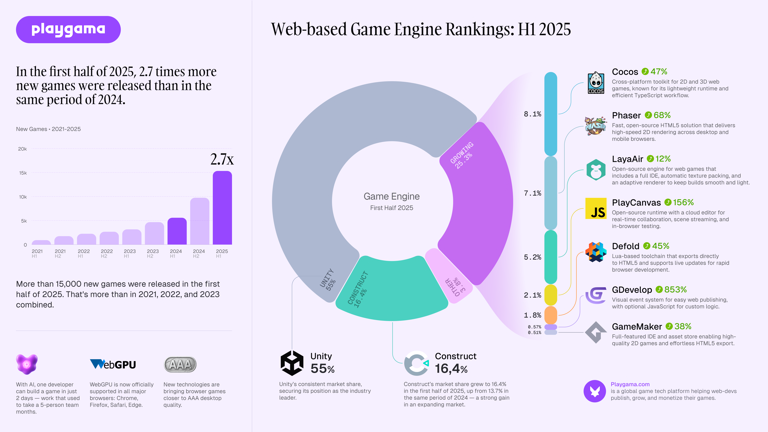
WebAssembly and WebGL are now standard across every major browser. They let developers export full game projects directly to a format that runs in a tab — no plugin, no install, no platform certification. Unity leads the market, powering 55% of new web games in Q2 2025 (Playgama, 2025). But it’s far from the only engine in play. Godot, Babylon.js, PlayCanvas, Three.js, and GameMaker all have HTML5 export pipelines. So does almost every other modern game engine worth knowing. If a developer can export their project as an HTML5 build, it can run in a browser — and on VIVERSE. That breadth is part of why the catalog has grown so fast.
The result is a more diverse catalog than the web has seen before — ranging from quick casual sessions to deeper experiences that can hold a player for an hour or more. VIVERSE reflects that variety directly. Its library includes games built across all the major web game engines, not just Unity titles.
VIVERSE reflects that variety directly. Its library includes games built across all the major web game engines, not just Unity titles.
Why the no-download advantage matters more now
The friction of installation is easy to underestimate until you remove it. A web game loads in a tab. You play. You close the tab. Nothing persists on your device unless you want it to.
That matters differently for different players. For someone on a work laptop with locked admin rights, a browser game is often the only 3D game they can access. For a student on a Chromebook — a device that held roughly 60% of the global education device market in 2025 (AboutChromebooks, 2026) — browser games are the primary gaming format. For anyone who just wants to try something without committing to a download, browser games remove the risk entirely.
Mobile has a version of this story too. Unity’s documentation confirms Web platform support for iOS Safari and modern Chrome builds, though heavier 3D titles perform best on newer hardware. Lightweight browser games run well across a wide range of devices.
The zero-friction model also changes how players discover games. A link is enough to start playing. That’s a distribution model that social media, content creators, and word of mouth can actually use — in a way that a store listing can’t replicate.
Where the catalog is growing
The 15,000-plus web games that launched in Q2 2025 alone didn’t all land in the same place. The browser game catalog is now spread across a range of platforms, each with a slightly different focus.
Some platforms focus on casual discovery — curated front pages, mainstream titles, quick-session games. Others are built for indie developers, with open upload models and large back catalogs of game-jam entries and experimental work. And some, like VIVERSE, are building something different: a 3D spatial layer that connects games, worlds, and community in the same environment.
VIVERSE hosts a growing library of free browser games you can play without a download or account. But it also lets you move between games inside a connected 3D world — which is a different experience from opening a new tab on a portal. If you’ve played through best indie web games on VIVERSE or spent time with a puzzle game like Cube 2048, you’ve already seen what that looks like in practice.
What this means for players in 2026
The practical takeaway is simple. The web game catalog in 2026 is large enough, and varied enough, that most players can find something worth their time without ever opening a launcher or downloading a file.
Puzzle games, rhythm games, strategy, platformers, sandbox experiences — all of these exist in browser-native form, and most of them are free to start. The quality ceiling has risen too. A browser game in 2026 can look and feel close to a native build, especially on a mid-range or better device with a modern browser.
The category rewards exploration. The barrier to trying something new is low enough that there’s no reason not to.
Frequently Asked Questions
Are web games free to play?
Most web games are free to start, and many are completely free with no paywalls at all. Some offer optional purchases for cosmetics, extra levels, or premium content, but the base experience is typically available without spending anything. On VIVERSE, all games in the library are free to play — no purchase required, and no account needed to get started.
Do web games work on mobile?
Many do, though performance varies by game and device. Lightweight 2D games and casual titles generally run well on modern iOS and Android browsers. Heavier 3D games perform best on newer hardware. If a game is optimized for mobile, it’ll usually say so on its game page. When in doubt, it takes five seconds to find out — just open the link.
Do I need an account to play games on VIVERSE?
No. You can browse and play games on VIVERSE without creating an account or signing in. An account unlocks extras like saving progress, accessing your avatar, and connecting with other players — but it’s not a requirement to start playing.
What kinds of games are available as web games in 2026?
More than most people expect. The browser game catalog in 2026 covers puzzle games, platformers, rhythm games, strategy games, sandbox experiences, shooters, card games, and narrative games. Some are quick five-minute sessions. Others are deep enough to hold a player for hours. The range has expanded significantly as more experienced studios have started publishing web-native builds alongside their native releases.
Are web games as good as downloaded games?
It depends on what you’re measuring. On pure performance ceiling, a native build of the same game will have an edge — more memory headroom, faster load times for large assets, and access to platform-specific features. But the gap has narrowed significantly with WebAssembly and WebGL 2. For most casual and mid-core experiences, a well-optimized web game is hard to tell apart from its downloaded equivalent. And for players who don’t want to manage installs, patches, and storage limits, the web version is often the better practical choice.