The Obscura Society is built for lingering, not scrolling

It started with a question about wonder. Atlas Obscura wanted to know what curiosity feels like when it’s shared in real time. The answer became a lounge-like world where you can wander, chat, and discover stories together.
This written interview shares the story behind The Obscura Society and how it landed on VIVERSE. Atlas Obscura and New Canvas walk us through the spark that started it, the design choices that shaped it, and the thinking behind publishing it on the open web.
There’s a specific kind of magic that happens when Atlas Obscura leaves the stillness of a 2D page. In The Obscura Society, curiosity gets a room to move around in. You can wander, pause, and stumble into stories the way you do in real life, one surprising thread at a time.
Step into The Obscura Society on the web.
The spark: building a place, not another page
Atlas Obscura already helps people fall down rabbit holes. But The Obscura Society was meant to do something a standard page can’t. It was built to hold the feeling of collective discovery, without losing the trust Atlas has earned.
“Atlas Obscura has always been about more than information. It’s about wonder, grounded in trusted storytelling and community. We’re constantly looking to create new ways for people to experience the incredible places we cover together, and we started asking ourselves: What does curiosity feel like when it’s shared in real time? A traditional article or landing page couldn’t fully hold that feeling of collective discovery. The Obscura Society emerged from that realization — not as a replacement for AtlasObscura.com, but as a complementary place where the same trusted content could be explored in a more social, experiential way.”
– Doug Baldinger, Chief Content Officer, AO Entertainment
That shift changes the whole format. A page is something you finish. A place is something you come back to. For Atlas Obscura, the idea of an embeddable world also made room for the kinds of real-time moments that a typical article format can’t capture.
Atlas Obscura’s stories already move. The immersive format adds a new kind of movement, one of people exploring together. It gives the Atlas archive a setting where coincidence and conversation can happen in real time.
“Real-time conversation, coincidence and lingering, this was a way to capture those elements with the same editorial integrity people expect from Atlas Obscura.“
– Doug Baldinger, Chief Content Officer, AO Entertainment
A digital third place, with presence over performance
Atlas Obscura describes The Obscura Society as a “digital third place,” an online space where people casually gather, linger, and connect around shared interests and community. It’s a simple phrase, but it sets a high bar. The space has to support conversation and repeat visits. It also has to feel unhurried, like the kind of place you’d stumble into, then stay longer than planned.
“In practice, [a digital third place] means extending Atlas Obscura’s role as a trusted guide into a new kind of environment…one that prioritizes presence over performance. It’s designed to create a space where curiosity can be social, unhurried, and communal, like the salons and gathering places that historically shaped cultural exchange.”
– Doug Baldinger, Chief Content Officer, AO Entertainment
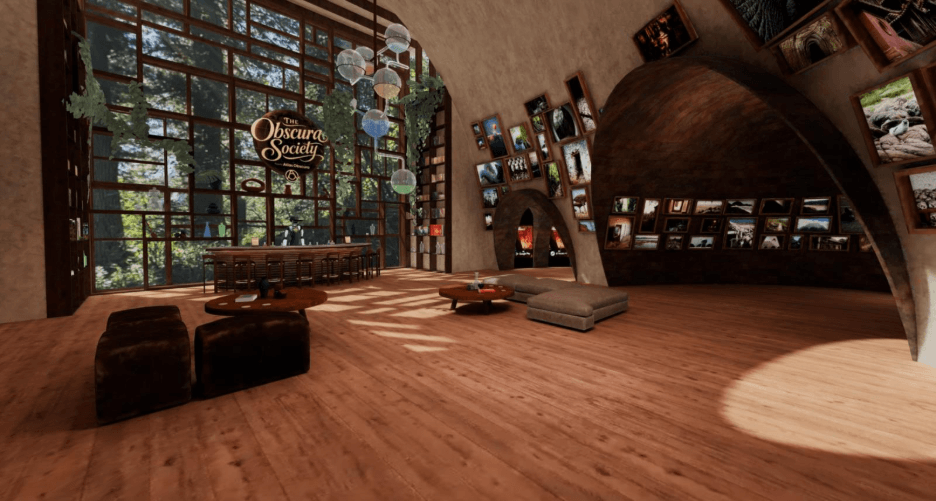
A “third place” only works if it holds up on the second visit. That’s where The Obscura Society is designed to deepen. The more time you spend, the more you can pull from it.
“We designed the experience to be a deep well, both in terms of the information you can access and the variety of people or perspectives you can encounter. Chat with new guests, follow your curiosity and dive deeper into something that sparked your attention on your first visit. We think we’ve built something that rewards attention and trust over time.”
– Doug Baldinger, Chief Content Officer, AO Entertainment
Tone was the non-negotiable constraint
Moving from editorial to immersive storytelling introduces a real risk. You can make something visually impressive but lose the voice that made people care in the first place. Both teams treated tone as a core constraint, not a finishing touch.
“The tone [should feel instantly like Atlas Obscura]: curious, thoughtful, slightly mischievous and all grounded in real stories. Also, a sense that they’re in good hands…that what they’re encountering is thoughtful, vetted and rooted in genuine curiosity about the world.”
– Doug Baldinger, Chief Content Officer, AO Entertainment
New Canvas built a lounge, not a checklist
New Canvas didn’t approach The Obscura Society as a level to complete. They approached it like a lounge you regularly return to. That framing helped keep the experience social and open-ended, without turning discovery into a task list.
“From the start, we framed it as a lounge: a persistent, social space designed for lingering rather than completion. That framing aligned instantly with Atlas Obscura’s sensibility and became the foundation for everything that followed. Early on, we even explored ways for visitors to contribute directly to the space, including the idea of inviting people to upload their own 360° and 180° photos onto a shared map inside the bar as a spatial extension of how Atlas Obscura’s community already shares stories and images on the site. Even as that idea evolved, it helped clarify the core goal: to build a place shaped by shared curiosity and participation, not passive consumption.“
– Wadooah Wali, Co-Founder and Chief Strategy Officer, New Canvas
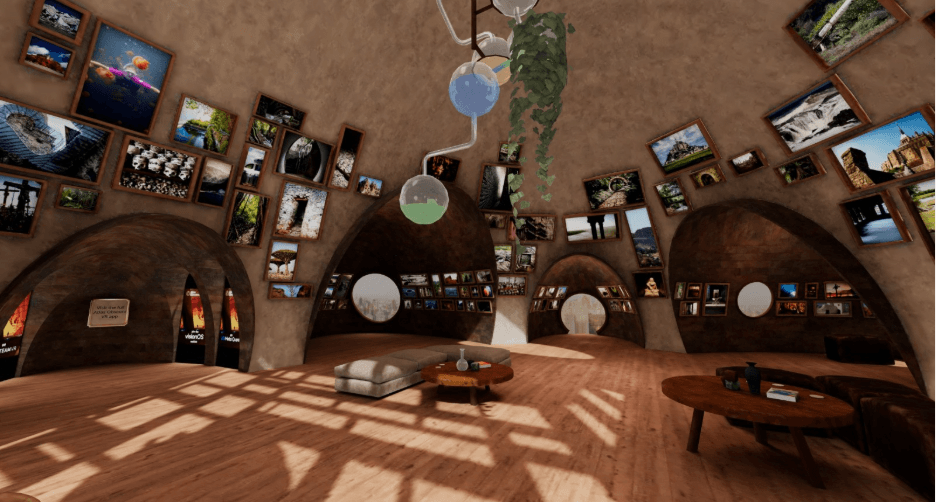
The “speakeasy meets chamber of wonders” concept gave that lounge a strong identity. It established warmth and intimacy first, then layered in moments that reveal themselves over time.
“The speakeasy [atmosphere] established the emotional baseline: warmth, intimacy, and the feeling of being let in on something slightly hidden. It’s human-scaled, softly lit, and designed for lingering rather than spectacle. The chamber of wonders layered in surprise with stories and objects that don’t announce themselves, but do reveal meaning through proximity and attention. Together, those ideas shaped a space that feels welcoming at first glance, then quietly strange the longer you stay.”
– Wadooah Wali, Co-Founder and Chief Strategy Officer, New Canvas
That’s where the “wandering” philosophy really clicks. The experience rewards attention. It also gives you permission to slow down.
The map: a familiar tool, reframed for curiosity
The Obscura Society taps into Atlas Obscura’s sense of place in a literal way. The map works as a familiar anchor for the community. It also acts as a quiet prompt. It suggests where you could go next, without trying to turn discovery into completion.
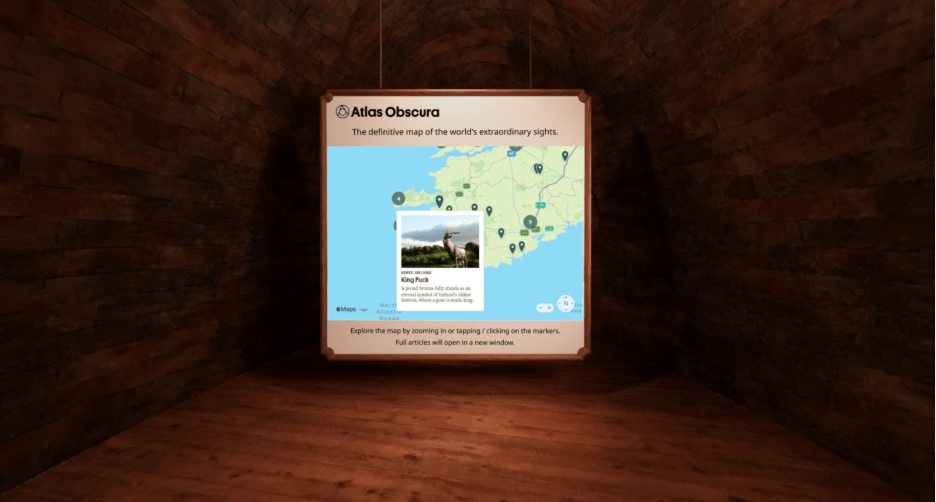
“We were very intentional about not reinventing something that already works for the Atlas Obscura community. The map is quite literally repurposed and iFramed from the existing Atlas Obscura site. That allowed us to maintain a familiar user experience while ensuring the data stays directly connected to the Atlas database. From a design perspective, we kept the map suggestive rather than exhaustive, which enables it to hint at possibility without explaining everything. It’s there to spark curiosity, not to demand completion.“
– Wadooah Wali, Co-Founder and Chief Strategy Officer, New Canvas
Why the AI bartender exists
Menus make discovery feel transactional. Feeds can make it feel endless. The AI bartender offered a third path: stories that surface through conversation.
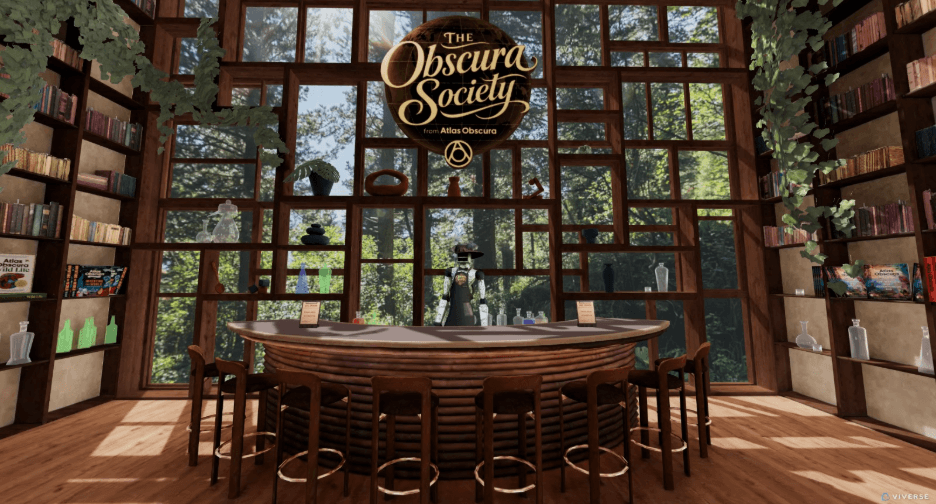
For Atlas Obscura, that fits their editorial mission. It mirrors how people actually find strange, wonderful things in the real world. You ask a question, get a lead, and end up somewhere you didn’t expect.
“When New Canvas proposed the idea of an AI bartender, it resonated immediately because it aligned so closely with how Atlas Obscura has always approached discovery. We try to help people find things they didn’t know they were looking for, and a conversational interface is a natural extension of that mindset. Instead of navigating menus or feeds, visitors encounter stories through dialogue, which might take them to a place they didn’t expect or wouldn’t have thought to search for directly. Crucially, the bartender is grounded in Atlas Obscura’s trusted editorial archive, ensuring that discovery remains contextual, thoughtful and anchored in the same standards people expect from our existing platforms.”
– Doug Baldinger, Chief Content Officer, AO Entertainment
New Canvas frames that same shift as a way to preserve the feeling of guided exploration, while still adapting naturally to a 3D environment.
“Shifting discovery from navigation to conversation [allows] stories to surface through dialogue rather than menus or prompts[, preserving] the feeling of guided exploration that defines Atlas Obscura, while adapting naturally to a 3D environment.”
– Wadooah Wali, Co-Founder and Chief Strategy Officer, New Canvas
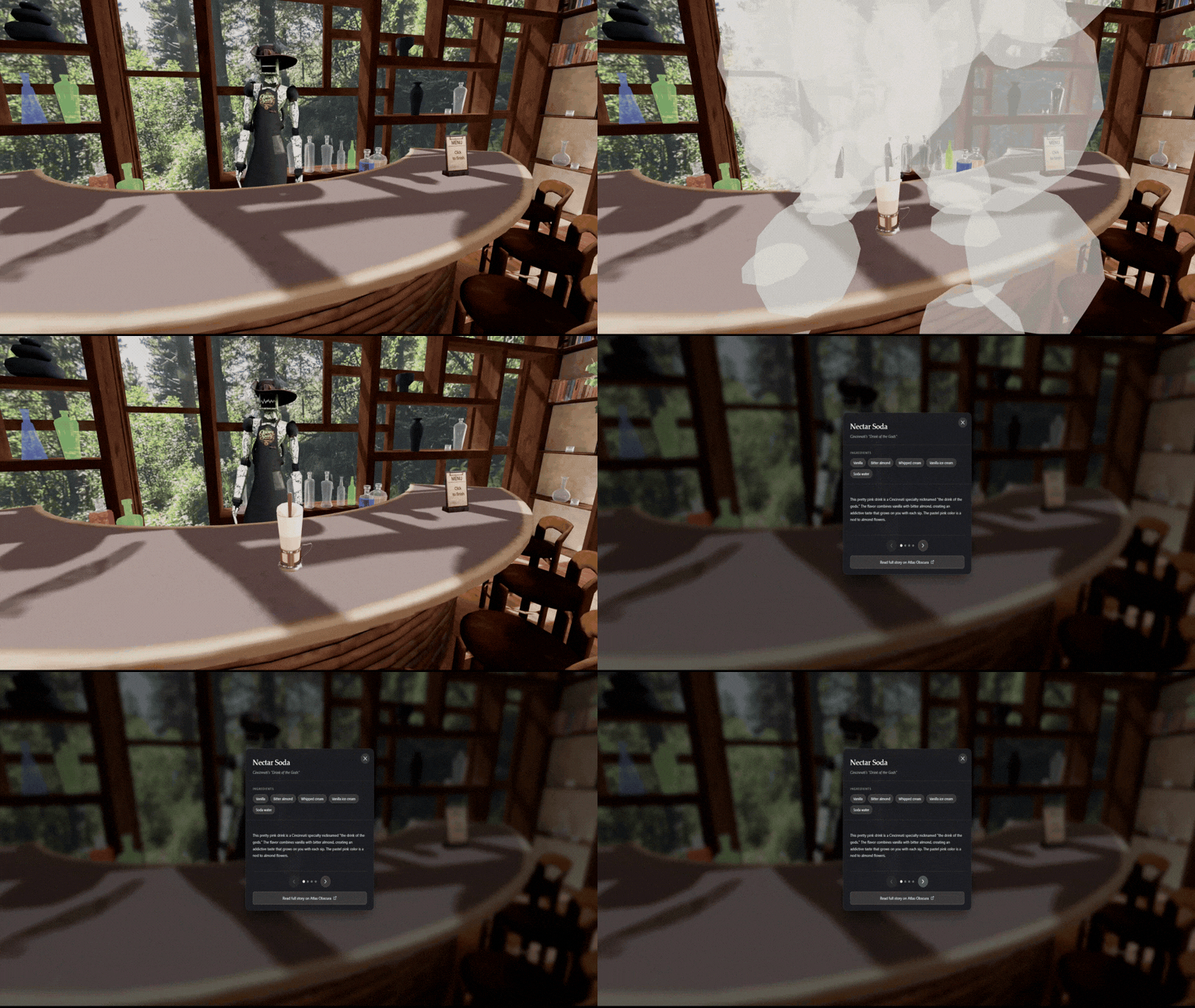
From New Canvas’s perspective, the AI bartender also makes the archive feel approachable. It’s a character, but it’s also a straightforward entry point into thousands of stories.
“When we started talking about the AI bartender, we decided this was a great idea as it [would] be a simple but effective way to leverage the existing 30k+ articles in the database and present them in a new and interesting way. We also like the social aspect of creating a bar or a lounge where people can come and hang out and chat/meet. Essentially, the concept really clicked as both an interface and a character.”
– Wadooah Wali, Co-Founder and Chief Strategy Officer, New Canvas
Atmosphere over spectacle was a real production choice
“Atmosphere over spectacle” isn’t just a creative preference. It becomes a production strategy. New Canvas chose to let the environment lead, then simplified everything else so the space could breathe.
“We made a conscious decision to let the environment lead and everything else follow. Early on, I knew that I wanted our team to include designers of real-world spaces, and so I made sure that we worked with architects at the concept stage, treating the space like a real place with emotional intent, not a feature container. That’s a different approach from most virtual worlds or game development, where mechanics often come first. By establishing tone, scale and spatial rhythm upfront, we were able to simplify aggressively elsewhere, pulling back on flashy mechanics, gamified loops and visual noise so the atmosphere could breathe and the experience could unfold more naturally.”
– Wadooah Wali, Co-Founder and Chief Strategy Officer, New Canvas
That same restraint shows up in what they chose to hold back in a “kill your darlings” decision. A jukebox would fit the fantasy, but it also risked becoming the point.
“One of the hardest decisions was postponing a jukebox feature that would let visitors personalize the music. It’s something you’d naturally expect in a bar. It was a feature we loved because it reinforced hospitality and agency, but we realized introducing it too early risked distracting from the core experience. Choosing to hold it back allowed us to focus on getting the fundamentals right: atmosphere, flow, and shared discovery. It’s very much a ‘not yet’ decision rather than a ‘not ever’ one.”
– Wadooah Wali, Co-Founder and Chief Strategy Officer, New Canvas
The shared goal: trust, wonder, and social curiosity
Even with different roles, both teams describe a consistent north star. The goal was to extend what Atlas Obscura already does best into a new format, without breaking the relationship they’ve built with their audience.
“From the beginning, the shared goal was to extend Atlas Obscura’s sense of trust and wonder into a new format without compromising either. Atlas Obscura has spent years building a relationship with its audience through thoughtful, rigorously vetted storytelling, and The Obscura Society was never about reinventing that relationship.
“Our aim was to make curiosity social without turning it into performance. Beyond [the] atmosphere, every design and functional decision was guided by the idea that this world should feel like a natural extension of Atlas Obscura itself: a quirky, wonderful brand whose sensibility stayed front of mind throughout development.“
– Wadooah Wali, Co-Founder and Chief Strategy Officer, New Canvas
Why it landed on VIVERSE
The Obscura Society needed to feel like part of the web, not apart from it. For Atlas Obscura, that meant publishing in a way that stays open and accessible. It also meant avoiding a gated experience that asks visitors to change their habits just to walk through the door.
“VIVERSE offered a way to publish a spatial experience with the same openness and accessibility that people expect from the web. For Atlas Obscura, that mattered deeply. The Obscura Society needed to feel like an extension of an existing digital ecosystem, not a gated destination that required new habits or commitments.”
– Wadooah Wali, Co-Founder and Chief Strategy Officer, New Canvas
That accessibility also shapes how both teams think about the bigger picture. If immersive experiences are going to grow, they need to meet audiences where they already are. Then they can invite people into deeper immersion when they’re ready.
“We love the accessibility of the VIVERSE platform. There is no other platform that is so open and easily accessible as VIVERSE. Across devices and hardware, as long as you have a browser, you should be able to visit it. We think this is a key area that requires further development in the immersive sector, being able to meet audiences on the devices they are using ([e.g.,] desktop, mobile) but also inviting them to dive deeper with a VR headset when they are ready.”
– Wadooah Wali, Co-Founder and Chief Strategy Officer, New Canvas
Visit The Obscura Society
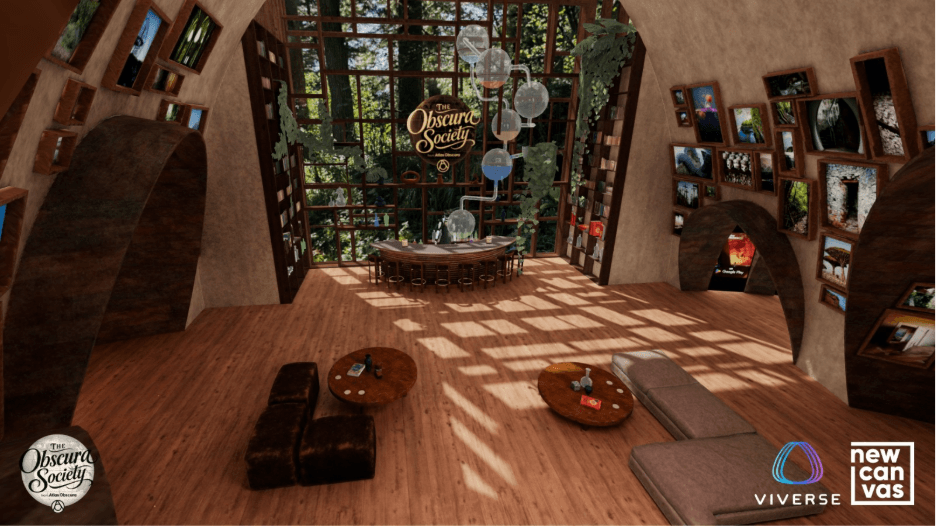
If you love strange stories and surprising places, The Obscura Society is worth visiting and revisiting, finding new paths to wander along. Open it like you’d open a door to a friend, not a tab. Strike up a conversation with those you meet and let the bartender help satisfy your curiosities.

Doug Baldinger Chief Content Officer, AO Entertainment
Baldinger leads Atlas Obscura’s entertainment business, producing award-winning content that reaches millions of travelers through books, podcasts, and films. Before his time at AO, Baldinger ran Global Creative Development for Blue Man Group.
LinkedIn · AtlasObscura.com

Wadooah Wali
Co-Founder & Chief Strategy Officer, New Canvas
A true media influencer, [Wadooah’s] 20+ career expertise spans across traditional & disruptive media platforms, including Demand Media, Facebook/Meta, Twitter (now X), WarnerMedia, Fullscreen & podcast leader Midroll Media/EarWolf (acquired by Scripps Media). LinkedIn · Instagram · NewCanvas.co